Today at 2011 International CES, T-Mobile USA, Inc. and LG Mobile Phones announced the upcoming Android™ Honeycomb-powered T-Mobile® G-Slate™ with Google™, by LG. Expected to be available in coming months, the G-Slate will be the first 4G tablet from the two companies powered by Android 3.0 (Honeycomb), the upcoming version of Google’s Android platform optimized for tablets.
“T-Mobile is proud to add a new milestone in the evolution of the Android platform with our first 4G tablet powered by Android 3.0,” said Cole Brodman, chief marketing officer, T-Mobile USA. “The T-Mobile G-Slate with Google will build on our rich history of Android innovation and leadership and deliver deep integration with Google services.”
“LG is dedicated to continuing its role as an innovation leader and is thrilled to announce its entry into the tablet marketplace with the G-Slate,” said Jeff Hwang, president of LG Mobile Phones. “Streamlining everyday tasks and enhancing entertainment with blazing fast 4G speed, the T-Mobile G-Slate by LG will deliver the latest in Android technology and provide users with an advanced tablet experience.”
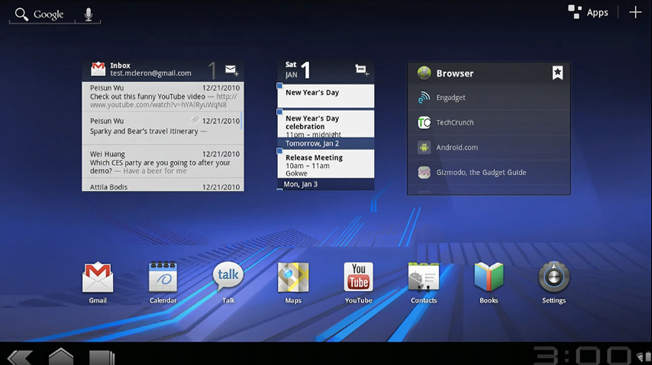
The T-Mobile G-Slate will be among the first 4G tablets to fully benefit from the tablet-optimized Android 3.0 platform, which was designed from the ground up for devices with larger screen sizes and addresses the unique aspects of tablet use cases and form factors. The Honeycomb user experience improves on Android favorites such as widgets, multi-tasking, browsing, notifications and customization. It will also feature the latest Google Mobile innovations including Google Maps™ 5.0 with 3D interaction, collection of more than 3 million eBooks and Google Talk™ with video and voice chat.With the ultra fast 4G capabilities, this is also the closest to the best home broadband speeds on offer currently.
Announced today is the T-Mobile Pulse, a prepaid-capable Android smartphone that utilizes a UI overlay known as Canvas. In terms of specs, the Pulse is quite capable with a 3.5-inch HVGA display, 3.2 megapixel camera, 2GB internal memory, 528MHz along with HSDPA, Wi-Fi and GPS radios. There are two features notably absent however; a flash for the camera and a 3.5mm headphone jack. Both T-Mobile and Huawei insist that their exclusion was necessary to keep the Pulse’s dimensions slim and trim at 160mm x 62.5mm x 13.5mm. Like it or not, the 3.5mm-less and flash-less Pulse will be as cheap as chips when it goes on sale this October: £179.99 ($293 USD) — or as low as 4.95€ in Germany with a 2-year agreement.
Not to be left out of the smartphone fleet week, T-Mobile releases the Dash 3G today. It’s a new version of their smartphone, the Dash. It’s similar to Sprint and Verizon’s HTC Snap and the first 3G phone to run the WinMo 6.1 platform. It has some marked design changes, mainly a trackball and more spaced out, round navigation keys instead of the cluster design. It still has the full QWERTY keyboard and it is has an overall sleeker shape.
No price point announced yet, but we do have some deets: QVGA (320 by 240 pixel resolution) display, integrated GPS, Exchange server support, microSDHC card slot, Bluetooth 2.0, and a 2-megapixel camera. It’s aiight, not quite as hardcore as the front runners, but it seems like it is a solid phone for someone who wants a smartphone of average intelligence. Hopefully, the price point will be as reasonable. The handset wil hit sometime in July. If you are looking for an entry level or gateway smartphone, this would be a good start. Unless you get swayed by the launch of the second T-Mobile phone with Android. Which is slated to happen next week!
In the spirit of the upcoming Earth Day, let’s peep the Motorola Renew, available from TMo.
A cute little bar phone, in green and white of course. Can’t have a “green” phone without it being colored green, can you?
The hook is that it has ecologically responsible retail packaging, includes a postage paid recycling envelope. The phone itself is made from recycled water bottles, and the plastic housing is 100% recyclable. Also, the battery life is upwards of 9hrs, so there is less charging time needed for this phone.
This phone also claims to be certified carbonfree through carbonfund.org. Through this Alliance, they will be used to offset the energy to manufacture, distribute and operate the phone by investing in renewable energy sources and reforestation.
The Deets? Meh. Very basic, no camera, no headset jack, but hey, it’s green and it’s cute.
Ok, we all know that I’m the biggest cheerleader for Google’s Android and I’m always in wait for news and updates about it. Well, the world’s cutest OS update build, Cupcake is almost done.
The Android Developers Blog announced today the availability of an “early look†Android 1.5 SDK. This release seems like a mostly complete version of the final release, though Google warns that some of the APIs are bound to change.
Beyond the features that v1.5 brings to the end user (see below), the new SDK carries a few key changes:
* The SDK now supports multiple versions of the platform, so developers can continue to work on applications for the current release (v1.1) while preparing their apps for the next one.
* Developers can now install SDK add-ons. This allows carriers, OEMs, and other third-parties to easily expand the SDK for their needs.
The Deets:
* On-screen keyboard support, with support for auto-correct, text prediction, user dictionaries, and third-party keyboard layouts
* Live folders (Auto-updating folder shortcuts for things such as YouTube favorites, Starred Contacts, and, with the API now available, whatever else developers conjure up)
* Video Recording
* MPEG4 and 3GP Video Playback
* Stereo Bluetooth
* Browser enhancements: New ultrafast “Squirrelfish†javascript engine, search within a page, copy and paste, UI changes
* New Linux Kernel
* Google Application enhancements: View Google Talk friend statuses in contacts, SMS, MMS, Gmail, and Email
* New frameworks for developers to build upon: Widget creation, Live Folder creation, Raw audio recording/playback, Video recording, Speech recognition
* Faster GPS, Faster camera startup, faster Gmail scrolling, and smoother browser scrolling
Peep the whole list here,
Following on the trail behind the LG Renoir, Samsung answers back with the similarly named Memoir and is coming to T-Mobile.
The Memoir, an 8mp, touch screen phone features a full HTML browser, virtual QWERTY and focuses on multimedia and online sharing. Working on T-mo’s 3G network, you can directly upload photos to such services as Flickr, Photobucket, Snapfish or Kodak Gallery. The camera sports a 16x digital zoom, xenon flash, shoots video and expandable memory up to 16 gigabytes. No onboard memory has been specified as of yet.
The cons, though, is a lack of wi-fi capability, which is a strange oversight, as T-Mo’s 3G network is in it’s infancy, spotty, and they are touting the Memoir’s online sharing as it’s main draw. It’s also not a smartphone. The TouchWiz interface runs over Win Mobile 6.1, but there are no apps for it. It may not be a full-on smartphone, but if you live a lifestyle free of a virtual leash, this is a pretty dope handset.
Pricing and availability date have not been officially announced, but the is speculated to drop Feb. 25, 2009 for $299 with 2 year contract.
Shortlist of the specs:
- 8 Megapixel Camera with Xenon flash and 16X digital zoom
- microSD slot for storage capacity expansion
- A-GPS for navigation and location based services
- 240 x 400 pixels touchscreen display (262k TFT)
- Full HTML browser and POP3 e-mail support
- TouchWiz interface with customizable widgets
- 3G/EDGE/GPRS data access speeds compatible
- Wireless Bluetooth 2.0 technology (Stereo)